

Are you creating alignment by design - or by accident?
Whether you realise it or not, you and your team are seeking alignment. We all are. It’s universal.
And yet, without an intentional way to create it, most teams end up on what I call The Accidental Journey to Alignment - a cycle that’s as familiar as it is painful.
The Accidental Journey has six stages. Five of them are hard - filled with heartache, discomfort, even despair. And the journey is rarely neat or linear. You don’t progress cleanly from one stage to the next; you loop back, repeat old lessons, and circle familiar terrain until the truth finally lands.
I know, because I’ve lived it. Many times.
The first stage is Misalignment - that quiet, internal dissonance that whispers, “This isn’t it.” Sometimes it feels like friction. Sometimes like freefall. But always, it’s a deep, bodily knowing that something is off. The rhythm of your work no longer matches the beat of your being, and everything around you starts to reverberate painfully.
From there, you may find yourself standing at The Edge of Alignment. This is the ache of almost - when you can glimpse what could be but can’t yet reach it. You taste belonging or contribution, but only in borrowed, fleeting ways. You start to see a new possibility, but the system - internal or external - won’t let you have it yet. So, you live in tension.
Then comes Rupture. The breaking point. The moment when holding it all together costs more than letting it fall apart. It’s terrifying - but it’s also honest. Rupture clears the ground. It exposes what was already broken and forces truth to the surface.
After rupture, most of us find ourselves Somewhere Between Collapse and Cadence - sitting in the rubble, not yet sure what to salvage. We begin again, often unsure where “again” will lead. It’s messy and humbling, but it’s also where something new begins to take shape - slowly, piece by piece.
Eventually, you reach It Wasn’t My Rhythm. This is where you realise you’ve been moving to someone else’s beat - the inherited beliefs, patterns, and systems that shaped you. You begin to ask why you carried them for so long. And in asking, you begin to let them go.
Finally, you arrive at Alignment. The moment where who you are and how you live, lead, and build are one and the same. You’re anchored in your purpose, grounded in your values, and connected to your truth. And when that happens - everything changes.
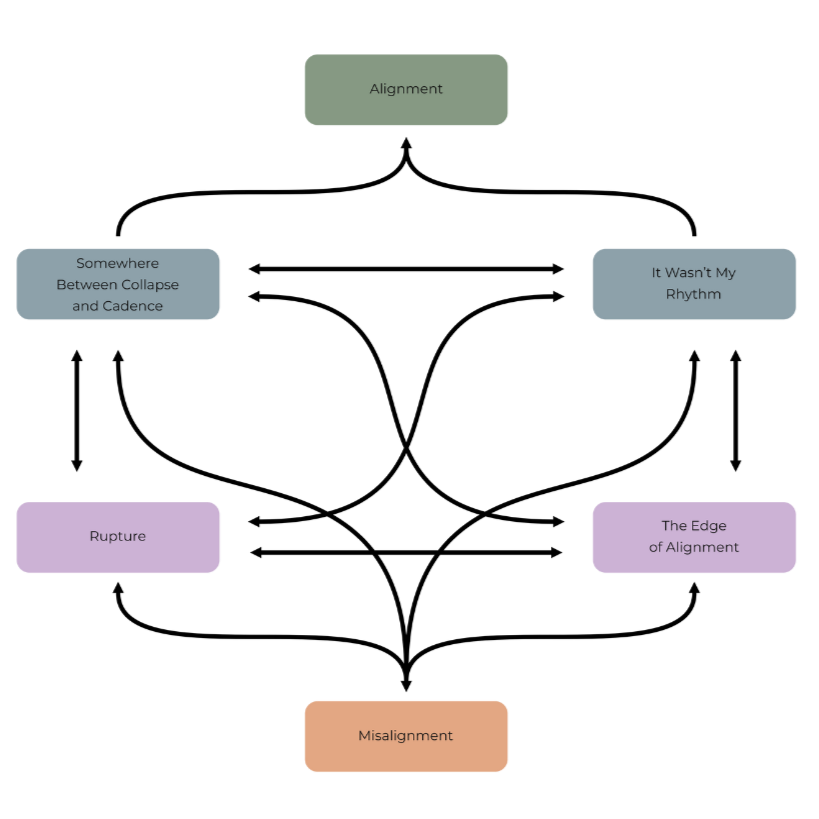
The Accidental Journey to Alignment
When I joined Teach Starter as CEO, I could see this journey reflected across the company.
In my first week, I met with as many people as I could and asked a simple question:
“Tell me what I need to know.”
And they did. I heard frustration, fatigue, disbelief. Some were deeply misaligned - in conflict with the business. Others hovered at the edge, able to see what was possible but powerless to reach it. A few were already in rupture, done and ready to leave.
But all of them were yearning for alignment.
The company had been living the accidental journey - reacting to symptoms instead of addressing the structure beneath them.
Once we reconnected purpose, values, and goals - once we introduced a deliberate framework for alignment - something profound happened. The noise quieted. Clarity returned. Energy followed.
The transformation wasn’t magic. It was designed.
Because without an architecture, alignment arrives like an earthquake - sudden, destructive, and disorienting. But when you build it with intention, alignment becomes a framework that holds growth instead of shattering under it.
The Cadence Method was born from this truth. It’s the architecture that transforms alignment from something accidental to something deliberate - from something reactive to something structural.
Most leaders don’t set out to create misalignment.
But without a method, it’s inevitable.
The Accidental Journey to Alignment is how most transformation happens - reactive, emotional, and expensive. It costs time, energy, trust, and confidence.
The alternative is intentional alignment: a system that brings truth and courage to the surface before crisis forces it. One that lets you design alignment rather than stumble toward it.
That’s the choice every leader faces.
Where in your leadership or business are you waiting for rupture - when you could be building alignment by design instead?